

TU Berlin paves way for scalable quantum chips
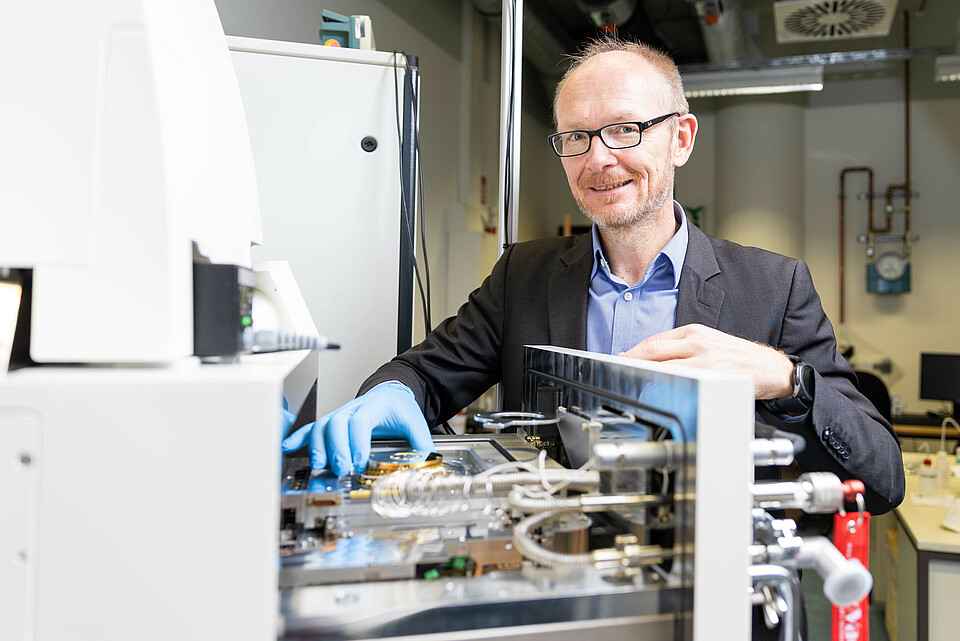
Prof. Dr. Stephan Reitzenstein - © Felix Noak
Berlin researchers have solved a problem that's been holding back quantum chip production for years: getting the light sources exactly where you want them.
According to a press release from TU Berlin, a team led by Prof. Stephan Reitzenstein at the university's Institute for Physics and Astronomy has found a way to grow quantum dots, the nanoscale structures that emit single particles of light, at precise, predetermined spots on a semiconductor chip. Working with colleagues from the University of Oldenburg, the group published the results in the journal Light: Science & Applications.
Until now, these quantum dots formed randomly during manufacturing, forcing researchers to hunt them down before building the optical structures around them. That worked fine for one-off lab demonstrations, but it made producing many high-quality light sources on a single chip extremely difficult.
The TU Berlin team's fix: a hidden layer built into the chip's substrate that creates precise material stress, guiding the quantum dots to grow exactly where they're needed during crystal growth itself.
The results speak for themselves. The researchers built a 6x6 grid of 36 light sources, and every single one worked. Nearly half of the generated light particles could be extracted for use, with a quantum purity above 99 percent, and the light particles behaved almost identically to one another, which matters a lot for applications like quantum computers and secure communication networks that need many photons interacting in exactly the same way.
Reitzenstein says the real significance isn't just the high yield, but proof that quantum photonics can move from individually tuned lab experiments to a scalable, industry-ready platform, a step that could bring optical quantum chips closer to real-world use.