
Diamond Qubits and Laser Pulses: Berlin's Quantum Leap
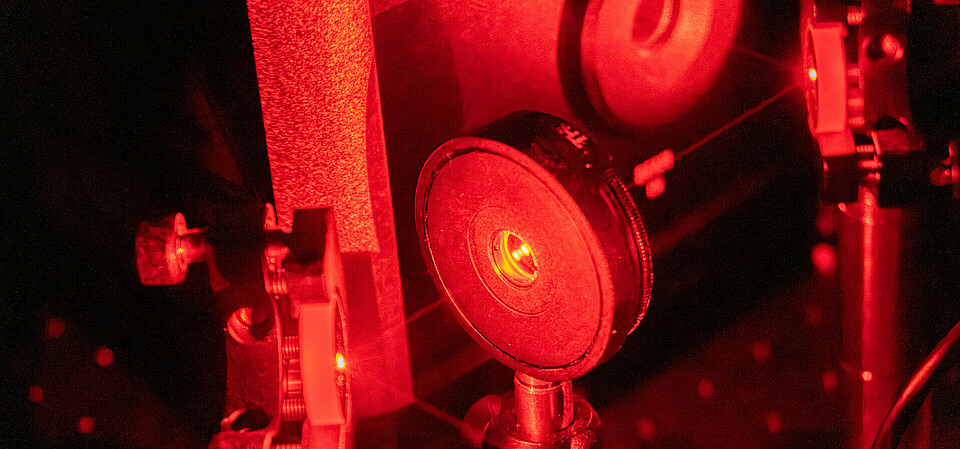
Part of the experimental setup for a quantum physics experiment in the laboratory of the Department of Physics at Humboldt University, Campus Adlershof. © Stefan Klenke/HU
Berlin is making moves in quantum tech. Researchers at Humboldt-Universität zu Berlin (HU Berlin) and the Joint Lab Diamond Nanophotonics at the Ferdinand-Braun-Institut (FBH) have demonstrated a new method for generating single photons in a diamond-based quantum system, according to a press release from HU Berlin. Their findings were published in the journal Nature Communications.
The team, led by Prof. Dr. Tim Schröder, used a technique called SUPER (Swing-UP of the quantum EmitteR population). Working together with colleagues from TU Dortmund, they applied two precisely tuned laser pulses to excite quantum systems built from diamond crystals. These crystals contain so-called tin vacancy centers, stable atomic structures that act as quantum bits (qubits) capable of storing and transmitting quantum information via photons.
What makes this approach stand out? The laser pulses operate in the femtosecond range, making them among the fastest optical control operations ever demonstrated for diamond-based systems. This speed allows researchers to separate control signals from the emitted photons much more cleanly than conventional methods, boosting efficiency and scalability.
There is another noteworthy result: the SUPER method preserves the quantum spin state of the system, which is essential for creating quantum entanglement between distant network nodes, a key building block for future quantum communication infrastructure.
The study combined diamond nanofabrication, ultrafast optics, and theoretical modelling to validate the approach. The results bring diamond-based quantum repeaters and distributed quantum computers closer to real-world application.
Berlin's quantum research scene is clearly one to watch.